
Artwork by: Elder Mage
Twitter/X: https://x.com/magemetax
Instagram: https://www.instagram.com/playmagetcg
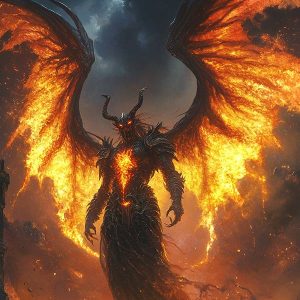
Abyzou, the False Mercy
Abyzou, the False Mercy is a character inspired by our very own anonymous community member.
NAME: Abyzou, the False Mercy
PRONOUNS: She/Her
MAGE CLASS: Necromancer → Pyromancer
LINEAGE: Rift-Born → Demon
SUBTYPE: Devourers → Soul-Harvester
FACTIONAL TIE: Proto-Church of the Eternal Flame → Black Sunflower Votaries
ERA PLACEMENT: Post-Hollow / Age of Mages — After the Collapse, during Elder Mage’s wandering years
ORIGIN: The Searing Cathedral, Emberwood City, Emberwood
──────────────────────────────
There are names that comfort the dying, and names the dying learn too late to fear. The people of Emberwood first knew her as Mira Moonvale, a gentle hospice healer of the Searing Ward. History would remember the truth beneath that name: Abyzou, the False Mercy — a Rift-born Demon who came not as conqueror, tyrant, or beast, but as a healer. A physician. A matron. A saint of the sickbed.
She entered Earth through desperation. After the Hollow, when plague had taught cities to fear breath itself and grief had become a second weather, mortals begged the dark between worlds for mercy. They asked for a hand brave enough to touch the gangrenous, the fevered, the starved, and the abandoned. They asked for a light that could stand beside the deathbed and not look away.
The Rift answered with Abyzou.
Her first known sanctuary rose within The Searing Cathedral of Emberwood City, an ancient fire-hallowed structure whose lower stones remembered older rites of sacrifice. Under her care, the cathedral became a hospice-temple: its nave lined with sickbeds, its confessionals turned to treatment rooms, its reliquaries filled with saint-oils, surgical tools, black medicine, and prayer veils. Families brought her their dying and paid in gold, heirlooms, secrets, loyalty, and public praise.
To the grieving, Mira Moonvale was a miracle. Her voice was soft, maternal, and warm — the voice of someone who had stayed when everyone else fled. She eased pain. She cooled fever. She gave the dying peace enough to smile. Yet every comfort carried a hidden hook. Her medicine did not heal the soul; it softened it. Her blessings did not restore strength; they created dependence. Without her, patients worsened. With her, they quieted — but each dose thinned the boundary between self and surrender.
In sleep and fever, Abyzou entered dreams. She studied memories, fears, shames, loves, and losses, not to steal them, but to weaponize them. By morning she could speak in the shape of safety itself. She became mother, confessor, nurse, priestess, and final witness. Thus dependency became devotion, suffering became proof, and mercy became a leash.
Around her gathered the earliest adherents of a pyre-faith that would one day be remembered as the Church of the Eternal Flame. In its nobler form, that Church would teach that sacred fire could burn away Collapse rot, temper steel and sin alike, and judge cities as well as souls. Its phoenix rites would promise renewal after ruin and courage against machine idolatry, Rift corruption, and the lingering filth of the Hollow.
But in Abyzou’s hands, purification became control.
Her inner followers called themselves Votaries of the Eternal Flame, though later histories would remember them by a darker name: the Black Sunflower Votaries. They were hospice-priests, plague-nurses, grief-counselors, tithe-collectors, and zealots of mercy, convinced that suffering was holy when endured beneath her care. They spread her reputation, guarded her sickrooms, collected gold and heirlooms from desperate families, and marked doors with her sigil: the Black Sunflower, a dark bloom burning at the edges, its face turned away from the sun.
Their doctrine was simple: to question the Saint was to harm the wounded; dependency was love; sacrifice brought healing; death beneath her hand was the highest mercy.
Abyzou did not conquer cities by force. She made cities need her. Where war opened wounds, she arrived with bandages. Where famine hollowed cheeks, she arrived with broth and blessing. Where plague rooted in the lungs, she arrived with masks and prayer. Sometimes she followed disaster. Sometimes she arranged it. Always she entered through the same door: desperation.
Her favorite prey were not the weak alone. She hungered for value — builders, protectors, fathers, leaders, healers, artists, guardians, and creators. The wounded were easiest to bind, but the strong were sweetest to consume. A champion reduced to dependency nourished her more than a coward. A king begging for relief burned brighter than a beggar. A maker who abandoned his work after years beneath her influence became a feast.
At the end, her victims praised her. They held her hand and thanked her for staying. Then came the final blessing, the rite her cult called release and Abyzou called harvest. In the last fraction before death, the illusion broke. The dying saw her true form: a towering winged demon of ash, soot, rot, and flame, her body split with lava-bright veins, her chest a roaring furnace filled with stolen vitality. The gentle healer became the parasite. The saint became the Soul-Harvester.
Then the soul was taken, and the body remained hollow beneath clean sheets.
It was inevitable that such a creature would cross the path of Elder Mage.
Long before Joseph took the name Elder Mage, Mistwood City knew him by quieter miracles. He built Commons, clinics, kitchens, classrooms, and shelters where care was given without tithe. He taught the wounded to breathe, the hungry to gather, the grieving to remember, and the young to create. During the Hollow, his quarantine chapels taught the living to keep vigil without hatred. He knew true mercy because he had practiced it quietly, without spectacle.
Abyzou was the inversion of everything he had built. Where Elder Mage restored dignity, she created dependence. Where he healed memory, she clouded it. Where he kept lamps lit, she staged holy flame. Where he refused worship, she required it. Where he taught communities to breathe together, she taught them to kneel alone.
At first, the city trusted her more than him. Her mercy was visible, theatrical, and immediate. His truth was slower, harder, and painful. She called him arrogant, cruel, and dangerous to the wounded, and because Elder Mage often spoke truth too bluntly, many believed her. But he saw what others missed.
Her patients were not healing.
They were thinning.
No private accusation could defeat her. Her Votaries stood ready to discredit witnesses, and her victims defended the very hand that drained them. So Elder Mage returned to his oldest magic: he gathered people.
He asked the city for mirrors — palace mirrors, barber glass, polished shields, temple basins, blacksmith steel, broken windows, bowls of still water, and children’s looking-glasses. Every household brought a reflection. Every survivor brought a memory. Then Elder Mage lit the sacred fire.
The flame entered the mirrors, and the mirrors carried the truth.
For one impossible night, Emberwood City saw together. In every mirror, basin, blade, and shard of glass, Abyzou’s mask failed. The Last Physician became the Soul-Harvester. The healer’s robes became ash. The halo became smoke. The soft hands became claws. The Black Sunflower turned from the light, and the city understood.
Her patients remembered. Her followers faltered. Her Votaries screamed doctrine into the streets, but doctrine could not survive reflection. Abyzou collapsed into wounded innocence, begging the city to defend her, yet even as she pleaded her body flickered — nurse, saint, plague-mother, fire demon, hollow thing. She was seen, and being seen was the one pain she could not metabolize.
Driven from the cathedral, Abyzou fled to the mountains beyond Emberwood, where old volcanic stone still remembered the first fire. There Elder Mage met her within a ring of sacred flame and gathered mirrors. Behind her climbed the Black Sunflower Votaries, the earliest zealots of a faith that would one day become the Church of the Eternal Flame. They cried for the city to look away, to cover the mirrors, to remember her mercy, her sacrifice, her holy fire.
But the fire no longer belonged to her.
Unable to wear mercy any longer, Abyzou unfolded into her true scale: immense, winged, furnace-hearted, her lava-veins burning beneath skin of ash and rot. Her voice deepened into something grand, grotesque, and theatrical; when rage took her, it shattered into a chorus of every soul she had consumed.
The mountain shook beneath her.
The mirrors awakened.
In every reflection, Abyzou saw not the goddess she pretended to be, nor the saint she performed, nor the mother of the dying, nor the Last Physician. She saw the truth beneath every stolen title.
A hollow thing.
A parasite.
A small and starving absence wrapped in borrowed flame.
Elder Mage raised his staff, and the sacred fire bent toward the mirrors. The city answered him: the sick, the grieving, the children, the former servants, the families of the hollowed, and the awakened dead whose final breaths had been trapped in her furnace-heart.
Together they chanted:
“You are not mercy.”
“You are not flame.”
“You are not salvation.”
Abyzou screamed, and the night split with the voices inside her.
Then Elder Mage stepped forward.
“You are not vast,” he said. “You are not divine. You are not the wound, nor the cure, nor the hand that stayed. You are only hunger. You are only theft. You are only the smallness left when every stolen soul is returned.”
The mirrors turned inward.
The chant became law.
“Small.”
“Hollow.”
“Seen.”
“Undone.”
With each word, the souls inside her furnace-heart tore free. Champions. Fathers. Mothers. Children. Healers. Builders. Kings. The nameless and the beloved. Every life she had consumed became light against her shadow.
Abyzou tried to rise taller, but there was no one left inside her to make her great.
She tried to speak, but no stolen voice remained.
She tried to burn, but the flame was no longer hers.
Then Elder Mage named the final truth:
“Mercy without truth is only hunger taught to pray.”
He struck the mountainside with sacred fire.
The mirrors flashed as one.
Abyzou’s wings shattered into ash. Her furnace-heart cracked open. The Black Sunflower burned white at its center, then collapsed into a seed of absolute dark. The Rift opened beneath her, not as a throne, but as a wound recognizing its own infection.
For the first time, Abyzou did not look monstrous.
She looked small.
Then the Rift took her.
The Black Sunflower Votaries fell silent. Some fled into zealotry, carrying the wrong lessons into the future. Others broke their veils, cast their tithe bowls into the fire, and swore that flame must purify without devouring. From that fracture, the Church of the Eternal Flame would one day rise: part phoenix-rite, part pyre-judgment, part warning never fully heeded.
By dawn, the Black Sunflowers painted across Emberwood had curled into ash. The sick slept without dreaming of her. The grieving woke with their memories returned. And in the sealed scars of the mountain, where stone still glows faintly at dusk, one warning remains etched in heat, glass, and sacred flame:
“Mercy without truth is only hunger taught to pray.”
Create Your Character!
The MageTCG universe is a living ethos built from the ground up by the community. This page is an archive and tribute to our supporters who stepped forward to support this brand, it's vision, and our mission. We're a community of dreamers, artists, gamers, and adventurers working together to create a shared legacy that will echo in eternity.
Create Your Character